Publications
Selected publications from the group.
For the full list, see my Google Scholar page.
2026
-
 Mendel Gödel Machine: Recursive Self-Improving Coding Agents via Comparative EvolutionChangzhi Liu, Yilun Liu, Sikuan Yan, Volker Tresp, and Yunpu MaarXiv preprint arXiv:2608.07645August 2026
Self-improving coding agents that iteratively rewrite their own source code have demonstrated impressive performance on coding tasks. However, existing solutions generally derive self-modification from a single failure trajectory at a time, overlooking rich comparative signals available in the agent’s expanding archive of past attempts. According to Mendelian principles of controlled inheritance, we introduce Mendel Gödel Machine (MGM). In addition to the general single-trajectory clonal mutation, MGM includes two new types of self-modification that better utilizes evidences accumulated: the reaction-norm mutation edits an agent based on its trajectories on multiple tasks simultaneously, and the cross-lineage hybridization edits an agent using the trajectory of a reference agent from another lineage on the same task. Under an additive fitness landscape model, we prove theoretically and demonstrate via controlled surrogate simulation that the new strategies facilitate a faster and better convergence over single-trajectory baselines. Experiments on SWE-bench and Polyglot confirm MGM’s consistent improvement in performance, efficiency, and generalizability.
@misc{liu2026mendelgodel, title = {Mendel {G\"odel} Machine: Recursive Self-Improving Coding Agents via Comparative Evolution}, author = {Liu, Changzhi and Liu, Yilun and Yan, Sikuan and Tresp, Volker and Ma, Yunpu}, note = {arXiv preprint arXiv:2608.07645}, year = {2026}, month = aug, } - NeurIPS 2026
 Memory-R2: Fair Credit Assignment for Long-Horizon Memory-Augmented LLM AgentsSikuan Yan, Ahmed Bahloul, Ercong Nie, Susanna Schwarzmann, Riccardo Trivisonno, Volker Tresp, and Yunpu MaIn Advances in Neural Information Processing SystemsDecember 2026
Memory-augmented LLM agents enable interactions that extend beyond finite context windows. Training such agents with reinforcement learning in multi-session environments is challenging because memory turns past actions into part of the future environment, making trajectory-level comparisons fundamentally unfair. We introduce Memory-R2 featuring LoGo-GRPO that combines local and global group-relative optimization. The global objective preserves end-to-end learning from long-horizon trajectory-level rewards, while local rerollouts compare different memory-operation outcomes from the same intermediate memory state, yielding fairer group comparisons and more precise supervision for memory construction. Memory-R2 jointly optimizes memory formation and evolution with a shared-parameter co-learning design and a progressive curriculum increasing training horizons from 8 to 32 sessions.
@inproceedings{yan2026memoryr2, title = {{Memory-R2}: Fair Credit Assignment for Long-Horizon Memory-Augmented {LLM} Agents}, author = {Yan, Sikuan and Bahloul, Ahmed and Nie, Ercong and Schwarzmann, Susanna and Trivisonno, Riccardo and Tresp, Volker and Ma, Yunpu}, booktitle = {Advances in Neural Information Processing Systems}, year = {2026}, month = dec, } - EMNLP 2026 Main
 PRISM: Self-Pruning Intrinsic Selection Method for Training-Free Multimodal Data SelectionJinhe Bi, Yifan Wang, Danqi Yan, Aniri, Wenke Huang, Zeyu Jin, Xiaowen Ma, Artur Hecker, Mang Ye, Xun Xiao, Hinrich Schuetze, Volker Tresp, and Yunpu MaIn Proceedings of the 2026 Conference on Empirical Methods in Natural Language ProcessingOctober 2026
Visual instruction tuning adapts pre-trained Multimodal Large Language Models (MLLMs) to follow human instructions, but the rapid growth of training datasets introduces significant redundancy. We identify a critical factor: the anisotropy inherent in visual feature distributions induces a Global Semantic Drift that limits data selection efficiency. Motivated by this insight, we devise PRISM, the first training-free framework for efficient visual instruction selection. PRISM removes the corrupting influence of global background features by modeling intrinsic visual semantics via implicit re-centering. PRISM reduces the end-to-end time for data selection and model tuning to just 30% of conventional pipelines while achieving a 101.7% relative improvement over the baseline.
@inproceedings{bi2025prism, title = {{PRISM}: Self-Pruning Intrinsic Selection Method for Training-Free Multimodal Data Selection}, author = {Bi, Jinhe and Wang, Yifan and Yan, Danqi and Aniri and Huang, Wenke and Jin, Zeyu and Ma, Xiaowen and Hecker, Artur and Ye, Mang and Xiao, Xun and Schuetze, Hinrich and Tresp, Volker and Ma, Yunpu}, booktitle = {Proceedings of the 2026 Conference on Empirical Methods in Natural Language Processing}, year = {2026}, month = oct, } - EMNLP 2026 Main
 Routing-Free Mixture of ExpertsYilun Liu, Jinru Han, Sikuan Yan, Volker Tresp, and Yunpu MaIn Proceedings of the 2026 Conference on Empirical Methods in Natural Language ProcessingOctober 2026
Standard Mixture-of-Experts (MoE) models rely on centralized routing mechanisms that introduce rigid inductive biases. We propose Routing-Free MoE, which eliminates any hard-coded centralized designs including external routers, Softmax, Top-K and load balancing, instead encapsulating all activation functionalities within individual experts and directly optimizing through continuous gradient flow. We introduce a unified adaptive load-balancing framework to simultaneously optimize both expert-balancing and token-balancing objectives through a configurable interpolation. Extensive experiments show that Routing-Free MoE consistently outperforms baselines with better scalability and robustness.
@inproceedings{liu2026routingfree, title = {Routing-Free Mixture of Experts}, author = {Liu, Yilun and Han, Jinru and Yan, Sikuan and Tresp, Volker and Ma, Yunpu}, booktitle = {Proceedings of the 2026 Conference on Empirical Methods in Natural Language Processing}, year = {2026}, month = oct, } - EMNLP 2026 Main
 Policy of Thoughts: Scaling LLM Reasoning via Test-time Policy EvolutionZhengbo Jiao, Hongyu Xian, Qinglong Wang, Yunpu Ma, Zhebo Wang, Dezhang Kong, and Meng HanIn Proceedings of the 2026 Conference on Empirical Methods in Natural Language ProcessingOctober 2026
Large language models (LLMs) struggle with complex, long-horizon reasoning due to instability caused by their frozen policy assumption. Current test-time scaling methods treat execution feedback merely as an external signal for filtering or rewriting trajectories, without internalizing it to improve the underlying reasoning strategy. Inspired by Popper’s epistemology of “conjectures and refutations,” we argue that intelligence requires real-time evolution of the model’s policy through learning from failed attempts. We introduce Policy of Thoughts (PoT), a framework that recasts reasoning as a within-instance online optimization process. PoT first generates diverse candidate solutions via an efficient exploration mechanism, then uses Group Relative Policy Optimization (GRPO) to update a transient LoRA adapter based on execution feedback. This closed-loop design enables dynamic, instance-specific refinement of the model’s reasoning priors. Experiments show that PoT dramatically boosts performance: a 4B model achieves 49.71% accuracy on LiveCodeBench, outperforming GPT-4o and DeepSeek-V3 despite being over 50 times smaller.
@inproceedings{jiao2026policythoughts, title = {Policy of Thoughts: Scaling {LLM} Reasoning via Test-time Policy Evolution}, author = {Jiao, Zhengbo and Xian, Hongyu and Wang, Qinglong and Ma, Yunpu and Wang, Zhebo and Kong, Dezhang and Han, Meng}, booktitle = {Proceedings of the 2026 Conference on Empirical Methods in Natural Language Processing}, year = {2026}, month = oct, } - EMNLP 2026 Main
 PyraVid: Hierarchical Multimodal Memory for Long-Horizon Video ReasoningSikuan Yan, Sicheng Dong, Haotong Wang, Ercong Nie, Yilun Liu, Jinhe Bi, Yingjie Xu, Susanna Schwarzmann, Riccardo Trivisonno, Volker Tresp, and Yunpu MaIn Proceedings of the 2026 Conference on Empirical Methods in Natural Language ProcessingOctober 2026
Memory has become an increasingly important component of agentic systems, as these systems are expected to reason over long-term experience. Multimodal memory introduces challenges including heterogeneous input integration, person-centric information alignment, and evidence aggregation across different granularities. We present PyraVid, a hierarchical multimodal memory framework inspired by Event Segmentation Theory from cognitive science. PyraVid organizes long videos into a coarse-to-fine pyramid structure, enabling structured memory access and effective evidence aggregation. It supports structure-guided memory expansion with pruning, allowing retrieval of related events with strong causal connectivity but low semantic similarity. Experiments on multiple long-video understanding benchmarks show that PyraVid consistently improves performance across datasets, model scales, and question types.
@inproceedings{yan2026pyravid, title = {{PyraVid}: Hierarchical Multimodal Memory for Long-Horizon Video Reasoning}, author = {Yan, Sikuan and Dong, Sicheng and Wang, Haotong and Nie, Ercong and Liu, Yilun and Bi, Jinhe and Xu, Yingjie and Schwarzmann, Susanna and Trivisonno, Riccardo and Tresp, Volker and Ma, Yunpu}, booktitle = {Proceedings of the 2026 Conference on Empirical Methods in Natural Language Processing}, year = {2026}, month = oct, } - EMNLP 2026 Main
 MemWM: Memory-Augmented Text-Based World ModelYujun Wang, Tao Zhang, Jinhe Bi, Aniri, Wenxuan Ye, Boliang Liu, Sikuan Yan, Shuning Wang, Xuebing Zhou, Soeren Pirk, Hinrich Schuetze, and Yunpu MaIn Proceedings of the 2026 Conference on Empirical Methods in Natural Language ProcessingOctober 2026
World models are increasingly used to support planning in agents by predicting how environment states evolve in response to agent actions. Yet fluent next-state predictions can still omit task-critical facts, corrupt product attributes, or apply incorrect transition rules. To address such systematic prediction errors, we introduce MemWM, a memory-augmented text-based world model. MemWM uses world memory, a curated memory bank of transition rules, state caches, and hard-to-predict facts, to condition next-state imagination. We evaluate factual state preservation with Structured State Fidelity (SSF), which scores predicted states through benchmark-specific facts and fields. Compared with SFT, memory-augmented training improves SSF by up to 206.3%. In the full planning setting, we keep the policy model frozen and provide policy-side world skill: retrieved task-level skills and step-wise corrective guidance for action selection. Across ALFWorld, WebShop, and ScienceWorld, memory-augmented agents improve downstream success over an SFT-trained world-model agent, with up to a 65.4% relative gain. Sensitivity analyses further show that retrieved memory improves task success and efficiency under different memory and action-budget settings.
@inproceedings{wang2026memwm, title = {{MemWM}: Memory-Augmented Text-Based World Model}, author = {Wang, Yujun and Zhang, Tao and Bi, Jinhe and Aniri and Ye, Wenxuan and Liu, Boliang and Yan, Sikuan and Wang, Shuning and Zhou, Xuebing and Pirk, Soeren and Schuetze, Hinrich and Ma, Yunpu}, booktitle = {Proceedings of the 2026 Conference on Empirical Methods in Natural Language Processing}, year = {2026}, month = oct, } - EMNLP 2026 Findings
 miniReranker: Efficient Multimodal Reranking through Visual Cache Reuse and Interaction SparsityYingqi Fan, Xuan Lu, Anhao Zhao, Junlong Tong, Ping Nie, Kai Zou, Yunpu Ma, Wei Zhang, and Xiaoyu ShenIn Findings of the Association for Computational Linguistics: EMNLP 2026October 2026
Multimodal large language models (MLLMs) have emerged as powerful rerankers for multimodal retrieval, but their fine-grained token-level interactions come at a substantial computational cost. In point-wise reranking, each query must be independently paired with many candidate documents, resulting in repeated computation over highly overlapping multimodal inputs. In this work, we propose miniReranker, an efficient MLLM reranking framework that reduces redundancy at multiple levels. First, we introduce a vision-first reformulation that aligns with native MLLM prompting formats while maximizing reuse of expensive visual representations through prefix caching. We then identify redundancy in model depth, cross-segment interactions, and visual token representations, motivating three complementary optimizations: early exit, interaction bands, and embedder-guided token pruning. Built on Qwen3-VL, miniReranker achieves similar performance while reducing active parameters to 58% and achieving nearly 3x training acceleration. When reranking top-100 candidates, it reduces reranking runtime by up to >99%, demonstrating that efficient MLLM reranking can be achieved without sacrificing quality.
@inproceedings{fan2026minireranker, title = {{miniReranker}: Efficient Multimodal Reranking through Visual Cache Reuse and Interaction Sparsity}, author = {Fan, Yingqi and Lu, Xuan and Zhao, Anhao and Tong, Junlong and Nie, Ping and Zou, Kai and Ma, Yunpu and Zhang, Wei and Shen, Xiaoyu}, booktitle = {Findings of the Association for Computational Linguistics: EMNLP 2026}, year = {2026}, month = oct, } - EMNLP 2026 Main
 From Theory to Practice: Benchmarking LLM Pruning Inference Acceleration under GEMM-Centric TaxonomyHaozhe Hu, Hao Wu, Anhao Zhao, Longwei Ding, Peiran Yin, Yunpu Ma, and Xiaoyu ShenIn Proceedings of the 2026 Conference on Empirical Methods in Natural Language ProcessingOctober 2026
Pruning has emerged as a dominant paradigm for accelerating large language model (LLM) inference, spanning a broad spectrum of methods that remove computation across tokens, layers, heads, dimensions, and attention patterns. Despite sharing the same objective, these pruning approaches induce fundamentally different execution behaviors, causing realized speedups to depend heavily on hardware and kernel implementations. Consequently, the practical acceleration benefits of different pruning families remain poorly understood. In this work, we introduce a GEMM-centric taxonomy that reorganizes existing pruning methods according to the logical M, N, and K dimensions of general matrix multiplication (GEMM). Leveraging this abstraction, we build a unified benchmarking framework that enables implementation-consistent comparison across the pruning design space and systematically characterizes the acceleration–quality Pareto frontier. Our results show that static depth pruning remains the strongest Pareto-optimal baseline and stays closest to its theoretical acceleration upper bound in memory-bounded scenarios. During prefill, the frontier transitions from static depth at low quality loss (0%–4%), to dynamic depth at moderate loss (5%–16%), and finally to static width pruning at higher loss levels (17%–26%). These findings establish the first unified view of the practical limits of pruning-based LLM acceleration and provide guidance for future pruning research.
@inproceedings{hu2026beyondflops, title = {From Theory to Practice: Benchmarking {LLM} Pruning Inference Acceleration under {GEMM}-Centric Taxonomy}, author = {Hu, Haozhe and Wu, Hao and Zhao, Anhao and Ding, Longwei and Yin, Peiran and Ma, Yunpu and Shen, Xiaoyu}, booktitle = {Proceedings of the 2026 Conference on Empirical Methods in Natural Language Processing}, year = {2026}, month = oct, } -
 OPD-V: Visual On-Policy Self-Distillation with Modality BalanceAniri, Jinhe Bi, Peng Liao, Zengjie Jin, Volker Tresp, Fei Shen, Yunpu Ma, and Tat-Seng ChuaarXiv preprint arXiv:2608.05131August 2026
On-Policy Self-Distillation (OPSD) has become a standard post-training approach for improving visual reasoning in multimodal large language models (MLLMs). Existing methods draw privileged information from diverse input sources to guide self-distillation. Yet these designs overlook Modality Imbalance, a challenge inherent to MLLM reasoning. When textual information dominates generation, the model cannot fully integrate its multimodal input. Consequently, carefully designed privileged information remains underused, limiting the effectiveness of OPSD. To examine this limitation, we construct a Positive Teacher with the Zoom-In Image and a Negative Teacher with the Mask Image, which exhibit different degrees of Modality Imbalance. Changes in their reasoning correctness and token logits reveal that Modality Balance can itself serve as privileged information. Motivated by this finding, we introduce OPD-V, a visual OPSD paradigm that instantiates such information through the Positive Teacher and Negative Teacher. Positive Modality-Balance Logits Margins define a Modality-Balance Trust Region that selects the on-policy tokens used for self-distillation. Experiments across 6 benchmarks, 4 MLLM backbones, and 5 post-training methods show that OPD-V consistently improves reasoning performance while reducing training cost.
@misc{aniri2026opdv, title = {{OPD-V}: Visual On-Policy Self-Distillation with Modality Balance}, author = {Aniri and Bi, Jinhe and Liao, Peng and Jin, Zengjie and Tresp, Volker and Shen, Fei and Ma, Yunpu and Chua, Tat-Seng}, note = {arXiv preprint arXiv:2608.05131}, year = {2026}, month = aug, } -
 ReflectRL: Learning from Golden Negative Trajectories via Reflective-to-Direct ReasoningJinhe Bi, Chennan Zhou, Zengjie Jin, Aniri, Shuo Lu, Wenke Huang, Hu Cao, Xun Xiao, Zhihong Zhu, Volker Tresp, Fei Shen, Yunpu Ma, and Tat-Seng ChuaarXiv preprint arXiv:2608.03972August 2026
On-policy training has emerged as a powerful post-training paradigm for improving the reasoning capabilities of large language models, and is often enhanced by golden trajectories from stronger expert models. However, when the expert fails on harder problems, existing trajectory-guided methods lose their main source of supervision, and these failed trajectories are typically discarded as negative samples. We argue that such failures, which we call Golden Negative Trajectories, can still provide valuable reasoning signals when treated not as demonstrations to imitate, but as flawed trajectories to reflect upon. We identify a Reflection Advantage: for hard problems, reflecting on a flawed trajectory can be easier and more effective than solving the problem directly from scratch. Motivated by this, we propose ReflectRL, a lightweight plug-and-play framework that learns from Golden Negative Trajectories during on-policy training. ReflectRL first uses these trajectories to elicit Reflective Reasoning, then applies Reflective-to-Direct Policy Transition to transfer the acquired reasoning behavior back to Direct Reasoning. Experiments across 9 benchmarks, 4 LLM backbones, and 4 on-policy training methods show that ReflectRL consistently improves reasoning performance with minimal overhead.
@misc{bi2026reflectrl, title = {{ReflectRL}: Learning from Golden Negative Trajectories via Reflective-to-Direct Reasoning}, author = {Bi, Jinhe and Zhou, Chennan and Jin, Zengjie and Aniri and Lu, Shuo and Huang, Wenke and Cao, Hu and Xiao, Xun and Zhu, Zhihong and Tresp, Volker and Shen, Fei and Ma, Yunpu and Chua, Tat-Seng}, note = {arXiv preprint arXiv:2608.03972}, year = {2026}, month = aug, } - KDD 2026
 WIDE: Boosting Adaptive LLM Inference via Token-level Dynamic Width PruningHaozhe Hu, Hao Wu, Peiran Yin, Chao Han, Yunpu Ma, and Xiaoyu ShenIn Proceedings of the 32nd ACM SIGKDD Conference on Knowledge Discovery and Data MiningAugust 2026
Pruning is a promising approach for improving the efficiency of large language models (LLMs). Existing static structured pruning methods are hardware-friendly and can deliver practical throughput gains, but their input-agnostic computation allocation often causes substantial accuracy degradation under aggressive sparsity. Recent dynamic sparsity methods improve quality retention by adapting computation to individual inputs, yet they remain largely limited to coarse-grained structural decisions and their practical acceleration under real-world inference scenarios remains challenging. To address these challenges, we present WIDE, the first end-to-end differentiable token-level dynamic width pruning framework designed for both prefill and decode scenarios. WIDE enables fine-grained computation allocation by allowing each token to dynamically select attention-head groups and FFN-channel groups, extending dynamic pruning beyond layer-level decisions to neuron-block-level granularity. Through a two-stage training pipeline, WIDE learns effective token-wise sparse execution patterns and achieves substantially better quality retention than existing approaches. To make such fine-grained dynamic pruning practical, we further propose a pruning–kernel co-design framework that decomposes dynamic sparsity acceleration into mask reordering, hardware-agnostic block-level skipping, and hardware-dependent intra-block skipping, enabling efficient execution across different granularities. At 50% sparsity, WIDE provides 55.1% performance boost when compared to the state-of-the-art dynamic depth pruning under calibration-only settings. Under prefill and decoding inference workloads, WIDE achieves close-to-theoretical kernel-level speedups of up to 1.98x for prefill and 4.95x for decoding, as well as 1.68x and 1.55x end-to-end acceleration. These results establish WIDE as an effective fine-grained dynamic width pruning framework that pushes the frontier of token-wise dynamic structured pruning.
@inproceedings{hu2026wide, title = {{WIDE}: Boosting Adaptive {LLM} Inference via Token-level Dynamic Width Pruning}, author = {Hu, Haozhe and Wu, Hao and Yin, Peiran and Han, Chao and Ma, Yunpu and Shen, Xiaoyu}, booktitle = {Proceedings of the 32nd ACM SIGKDD Conference on Knowledge Discovery and Data Mining}, year = {2026}, month = aug, } -
 SearchEyes: Towards Frontier Multimodal Deep Search Intelligence via Search World SimulationZhengbo Jiao, Yiming Cheng, Yilei Jiang, Kaituo Feng, Rui Huang, Tianyi Jiang, Juanxi Tian, Jiapeng Li, Qunzhong Wang, Tailai Chen, Qianshan Wei, Chuan Xiao, Shanyu Rong, Yangfu Li, Yanhan Zhou, Yunpu Ma, Yifan Zhang, and Xiangyu YuearXiv preprint arXiv:2607.05943July 2026
Training multimodal search agents to perform multi-hop reasoning remains challenging due to a fundamental structural disconnect: existing pipelines construct training data, search environments, and reward signals independently, causing synthesized structural metadata to be discarded, environments to rely on irreproducible external engines, and RL rewards to remain sparse at the trajectory level. We present SearchEyes, which uses a typed knowledge graph as the backbone of a simulated search world that unifies all three components. We propose Perception-Knowledge Chains (PKC) to sample constrained multi-hop paths over the visual-knowledge intersection of Wikidata5M, retaining hop-level entity metadata that simultaneously defines a self-contained search world and step-level reward anchors. We further propose Hop-Anchored Policy Optimization (HaPO), which reuses these anchors for step-level credit assignment without a separately trained process reward model. Experiments on six multimodal knowledge-intensive benchmarks show that SearchEyes achieves state-of-the-art performance among open-source multimodal search agents, with SearchEyes-27B improving over the strongest open-source baseline by 6.2 points on average.
@misc{jiao2026searcheyes, title = {{SearchEyes}: Towards Frontier Multimodal Deep Search Intelligence via Search World Simulation}, author = {Jiao, Zhengbo and Cheng, Yiming and Jiang, Yilei and Feng, Kaituo and Huang, Rui and Jiang, Tianyi and Tian, Juanxi and Li, Jiapeng and Wang, Qunzhong and Chen, Tailai and Wei, Qianshan and Xiao, Chuan and Rong, Shanyu and Li, Yangfu and Zhou, Yanhan and Ma, Yunpu and Zhang, Yifan and Yue, Xiangyu}, note = {arXiv preprint arXiv:2607.05943}, year = {2026}, month = jul, } - ICML 2026
 The Geometry of Reasoning: Self-Evaluation via Layerwise Trajectory EvolutionJinhe Bi, Danqi Yan, Yifan Wang, Wenke Huang, Haokun Chen, Guancheng Wan, Mang Ye, Xun Xiao, Hinrich Schuetze, Volker Tresp, and othersIn International Conference on Machine LearningJuly 2026
Large Reasoning Models (LRMs) enhance performance by generating explicit Chain-of-Thought (CoT) trajectories, yet enabling them to self-evaluate correctness without external supervision remains a critical challenge. Existing methods often rely on ground-truth labels or shallow output probabilities, neglecting the layerwise evolution of the reasoning trajectory. In this work, we introduce GoR (Geometry of Reasoning), a white-box self-evaluation framework based on layerwise trajectory evolution. GoR decomposes reasoning fidelity into two complementary dimensions: (1) Geometric Evolution, which synthesizes the first- and second-order evolution of layerwise hidden-state trajectories to quantify geometric progress in reasoning; and (2) Difficulty-Aware Calibration, which utilizes cross-entropy of reasoning progress to normalize the Geometric Evolution against intrinsic query uncertainty. By jointly modeling these factors, GoR effectively distinguishes the coherent evolution of correct reasoning from the chaotic trajectories of errors. Extensive experiments across eight LRMs and seven benchmarks demonstrate that GoR consistently outperforms state-of-the-art baselines in AUROC, AUPR, and FPR@95.
@inproceedings{bi2026geometry, title = {The Geometry of Reasoning: Self-Evaluation via Layerwise Trajectory Evolution}, author = {Bi, Jinhe and Yan, Danqi and Wang, Yifan and Huang, Wenke and Chen, Haokun and Wan, Guancheng and Ye, Mang and Xiao, Xun and Schuetze, Hinrich and Tresp, Volker and others}, booktitle = {International Conference on Machine Learning}, year = {2026}, month = jul, } - ICML 2026
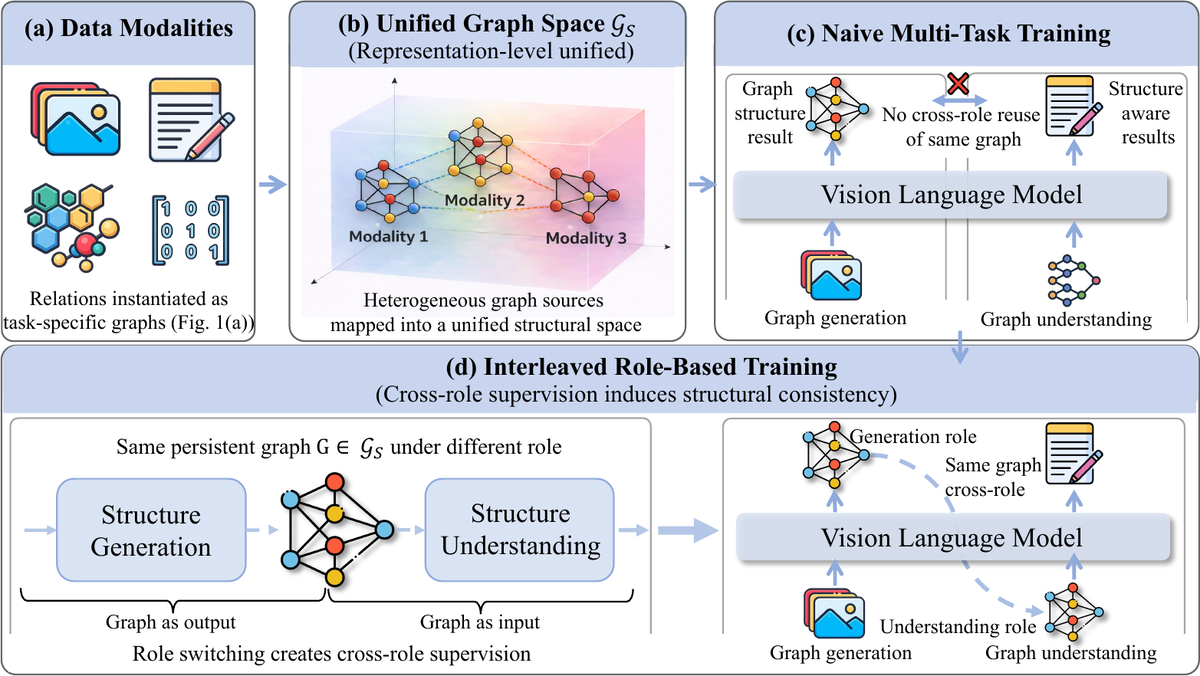 Graph is a Substrate Across Data ModalitiesZiming Li, Xiaoming Wu, Zehong Wang, Jiazheng Li, Yijun Tian, Jinhe Bi, Yunpu Ma, Yanfang Ye, and Chuxu ZhangIn International Conference on Machine LearningJuly 2026
Graphs provide a natural representation of relational structure that arises across diverse domains. Despite this ubiquity, graph structure is typically learned in a modality- and task-isolated manner, where structural regularities across modalities and tasks are repeatedly reconstructed rather than accumulated at the level of intermediate graph representations. We adopt a representation-centric perspective in which graph structure is treated as a structural substrate that persists across learning contexts. We propose G-Substrate, comprising a unified structural schema that ensures compatibility among graph representations across heterogeneous modalities and tasks, and an interleaved role-based training strategy that exposes the same graph structure to multiple functional roles during learning. Experiments across multiple domains, modalities, and tasks show that G-Substrate outperforms task-isolated and naive multi-task learning methods.
@inproceedings{li2026graphsubstrate, title = {Graph is a Substrate Across Data Modalities}, author = {Li, Ziming and Wu, Xiaoming and Wang, Zehong and Li, Jiazheng and Tian, Yijun and Bi, Jinhe and Ma, Yunpu and Ye, Yanfang and Zhang, Chuxu}, booktitle = {International Conference on Machine Learning}, year = {2026}, month = jul, } - ICML 2026
 Select to Think: Unlocking SLM Potential with Local SufficiencyWenxuan Ye, Yangyang Zhang, Xueli An, Georg Carle, and Yunpu MaIn International Conference on Machine LearningJuly 2026
Small language models (SLMs) offer efficient deployment, yet often lag behind LLMs in reasoning. We identify local sufficiency: at divergence points, the LLM’s preferred token often resides within the SLM’s top-K next-token predictions, even when failing to emerge as the SLM top-1 choice. We propose Select to Think (S2T), which reframes the LLM’s role from open-ended generation to selection among the SLM’s proposals, simplifying supervision to discrete candidate rankings. We introduce S2T-Local, which distills the selection logic into the SLM for autonomous re-ranking without inference-time LLM dependency. A 1.5B SLM’s top-8 candidates contain the 32B LLM’s choice with a 95% hit rate, and S2T-Local improves the 1.5B SLM’s Math Avg. over greedy decoding by 24.1% relative gain.
@inproceedings{ye2026selecttothink, title = {Select to Think: Unlocking {SLM} Potential with Local Sufficiency}, author = {Ye, Wenxuan and Zhang, Yangyang and An, Xueli and Carle, Georg and Ma, Yunpu}, booktitle = {International Conference on Machine Learning}, year = {2026}, month = jul, } - ICML 2026
 EchoRL: Reinforcement Learning via Rollout EchoingJinhe Bi, Aniri, Minglai Yang, Xingcheng Zhou, Wenke Huang, Sikuan Yan, Yujun Wang, Zixuan Cao, Michael Faerber, Xun Xiao, Volker Tresp, and Yunpu MaIn International Conference on Machine LearningJuly 2026
Reinforcement Learning with Verifiable Rewards (RLVR) is an effective route for post-training to strengthen the reasoning capability of large language models. As training proceeds, a growing fraction of prompts’ rollouts become advantage-degenerated: all self-generated rollouts show verified-success, making the standard deviation of rewards zero and causing policy gradient to vanish. We propose EchoRL, which identifies an EchoClip from verified-success rollouts based on step-level entropy values and feeds this clip back as an auxiliary supervision signal in the RL objective. Extensive experiments across 10 benchmarks, 5 LLM backbones, and 4 popular RLVR post-training methods demonstrate that EchoRL consistently improves RLVR post-training with minimal overhead.
@inproceedings{bi2026echorl, title = {{EchoRL}: Reinforcement Learning via Rollout Echoing}, author = {Bi, Jinhe and Aniri and Yang, Minglai and Zhou, Xingcheng and Huang, Wenke and Yan, Sikuan and Wang, Yujun and Cao, Zixuan and Faerber, Michael and Xiao, Xun and Tresp, Volker and Ma, Yunpu}, booktitle = {International Conference on Machine Learning}, year = {2026}, month = jul, } -
 MetaSkill-Evolve: Recursive Self-Improvement of LLM Agents via Two-Timescale Meta-Skill EvolutionZefeng Wang, Minxi Yan, Jinhe Bi, Sikuan Yan, Volker Tresp, and Yunpu MaarXiv preprint arXiv:2607.05297July 2026
Recent LLM agents tackle increasingly long-horizon, open-ended tasks, and external skills, reusable procedural knowledge supplied to the agent, further extend this capability. However, a fixed, hand-authored skill is rarely optimal, and cannot adapt to the diversity of tasks an agent encounters. Self-improving agents address this by rewriting their own skill files from execution traces, yielding meaningful gains on challenging benchmarks. Yet such self-evolution remains non-recursive: it improves only the task skill (what the agent does) while the improvement procedure (how it improves) is authored once and held fixed. We introduce MetaSkill-Evolve, a two-timescale framework that makes agentic skill improvement recursive: every branch carries both a task skill s and a branch-local meta-skill m=(psi, sigma, alpha, pi, epsilon) whose five components parameterise the Analyzer, Retriever, Allocator, Proposer, and Evolver agents of the improvement pipeline. Task skills evolve on a fast loop while the meta-skill evolves on a slower one under the same pipeline applied to itself, with no additional model or objective. With all five pipeline agents sharing a single frozen backbone, MetaSkill-Evolve outperforms no-skill, static-skill, and single-level evolution baselines on three agentic benchmarks (OfficeQA, SealQA, ALFWorld), improving held-out test accuracy over the raw backbone by +23.54, +16.09, and +1.92 points respectively.
@misc{wang2026metaskillevolve, title = {{MetaSkill-Evolve}: Recursive Self-Improvement of {LLM} Agents via Two-Timescale Meta-Skill Evolution}, author = {Wang, Zefeng and Yan, Minxi and Bi, Jinhe and Yan, Sikuan and Tresp, Volker and Ma, Yunpu}, note = {arXiv preprint arXiv:2607.05297}, year = {2026}, month = jul, } - ICML 2026
 ProactiveLLM: Learning Active Interaction for Streaming Large Language ModelsJunlong Tong, Yao Zhang, Anhao Zhao, Yingqi Fan, Yunpu Ma, and Xiaoyu ShenIn International Conference on Machine LearningJuly 2026
Standard Large Language Models (LLMs) follow a “read-then-generate” paradigm, causing unnecessary latency and computation. Streaming LLMs alleviate this issue by generating while receiving inputs, but still struggle to decide when to interact with the stream. Existing methods either hard-code interaction timing or rely on costly external alignment signals, such as timing labels, reasoning trajectories, or stronger teachers. In this paper, we propose ProactiveLLM, which achieves active interaction by leveraging the model’s endogenous states to guide interaction decisions. The model first learns to perceive semantic sufficiency from partial inputs through two complementary training mechanisms: mask-based streaming modeling and synchronized privileged self-distillation (SPSD). The former applies monotonic random masking to the input during training, simulating progressively revealed streaming inputs and enabling the model to learn local semantic dependencies from partial-input views. The latter aligns the partial-context student view with a full-context teacher view generated by the same evolving model, allowing privileged full-context evidence to guide the student’s understanding under incomplete observations. Together, these mechanisms induce endogenous sufficiency cues without requiring external teachers or annotations, providing a versatile foundation for the plug-and-play integration of diverse decision heads. Extensive evaluation across text and speech streaming tasks confirms that ProactiveLLM significantly reduces interaction latency while maintaining quality, validating its capacity for dynamic and active interaction.
@inproceedings{tong2026proactivellm, title = {{ProactiveLLM}: Learning Active Interaction for Streaming Large Language Models}, author = {Tong, Junlong and Zhang, Yao and Zhao, Anhao and Fan, Yingqi and Ma, Yunpu and Shen, Xiaoyu}, booktitle = {International Conference on Machine Learning}, year = {2026}, month = jul, } - ACL Findings 2026
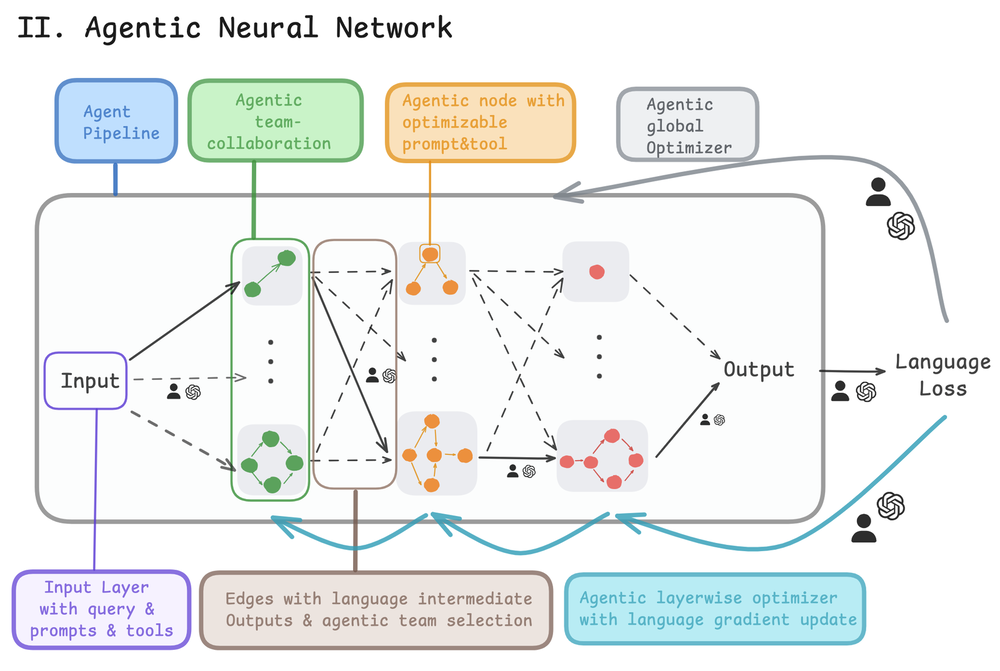 Self-Evolving Multi-Agent Systems via Textual BackpropagationXiaowen Ma, Yunpu Ma, Chenyang Lin, Sikuan Yan, Jinhe Bi, Zixuan Cao, Yijun Tian, Volker Tresp, and Hinrich SchuetzeIn Findings of the Association for Computational Linguistics: ACL 2026July 2026
Leveraging multiple Large Language Models (LLMs) has proven effective for addressing complex tasks, but current approaches rely on static, manually engineered multi-agent configurations. We present the Agentic Neural Network (ANN), a framework that conceptualizes multi-agent collaboration as a layered neural network architecture. Our framework follows a two-phase optimization strategy: (1) Forward Phase—tasks are dynamically decomposed into subtasks, and cooperative agent teams are constructed layer by layer; (2) Backward Phase—mirroring backpropagation, we refine collaboration through iterative feedback, allowing agents to self-evolve their roles, prompts, and coordination. Across seven benchmark datasets, our work surpasses leading multi-agent baselines under the same configurations.
@inproceedings{ma2025selfevolving, title = {Self-Evolving Multi-Agent Systems via Textual Backpropagation}, author = {Ma, Xiaowen and Ma, Yunpu and Lin, Chenyang and Yan, Sikuan and Bi, Jinhe and Cao, Zixuan and Tian, Yijun and Tresp, Volker and Schuetze, Hinrich}, booktitle = {Findings of the Association for Computational Linguistics: ACL 2026}, pages = {9918--9951}, year = {2026}, month = jul, } - ACL 2026
 Memory-R1: Enhancing Large Language Model Agents to Manage and Utilize Memories via Reinforcement LearningSikuan Yan, Xiufeng Yang, Zuchao Huang, Ercong Nie, Zifeng Ding, Zonggen Li, Xiaowen Ma, Jinhe Bi, Kristian Kersting, Jeff Z. Pan, Hinrich Schuetze, Volker Tresp, and Yunpu MaIn Proceedings of the 64th Annual Meeting of the Association for Computational LinguisticsJuly 2026
Large Language Models (LLMs) remain fundamentally stateless, constrained by limited context windows that hinder long-horizon reasoning. We present Memory-R1, a reinforcement learning framework that equips LLMs with the ability to actively manage and utilize external memory through two specialized agents: a Memory Manager that learns structured operations (ADD, UPDATE, DELETE, NOOP) and an Answer Agent that pre-selects and reasons over relevant entries. Both agents are fine-tuned with outcome-driven RL, enabling adaptive memory management with minimal supervision. With only 152 training QA pairs, Memory-R1 outperforms strong baselines and generalizes across three benchmarks (LoCoMo, MSC, LongMemEval) and multiple model scales (3B–14B).
@inproceedings{yan2025memoryr1, title = {{Memory-R1}: Enhancing Large Language Model Agents to Manage and Utilize Memories via Reinforcement Learning}, author = {Yan, Sikuan and Yang, Xiufeng and Huang, Zuchao and Nie, Ercong and Ding, Zifeng and Li, Zonggen and Ma, Xiaowen and Bi, Jinhe and Kersting, Kristian and Pan, Jeff Z. and Schuetze, Hinrich and Tresp, Volker and Ma, Yunpu}, booktitle = {Proceedings of the 64th Annual Meeting of the Association for Computational Linguistics}, pages = {12805--12825}, year = {2026}, month = jul, } - ACL 2026
 Mem²Evolve: Towards Self-Evolving Agents via Co-Evolutionary Capability Expansion and Experience DistillationZihao Cheng, Zeming Liu, Yingyu Shan, Xinyi Wang, Xiangrong Zhu, Yunpu Ma, Hongru Wang, Yuhang Guo, Wei Lin, and Yunhong WangIn Proceedings of the 64th Annual Meeting of the Association for Computational LinguisticsJuly 2026
While large language model-powered agents can self-evolve by accumulating experience or by dynamically creating new assets, existing frameworks treat these two evolutionary processes in isolation. We introduce a novel paradigm of co-evolutionary Capability Expansion and Experience Distillation. We propose Mem²Evolve, which integrates Experience Memory and Asset Memory, leveraging accumulated experience to guide the dynamic creation of assets while acquiring new experience to achieve co-evolution. Extensive experiments across 6 task categories and 8 benchmarks demonstrate that Mem²Evolve achieves improvement of 18.53% over standard LLMs, 11.80% over agents evolving solely through experience, and 6.46% over those evolving solely through asset creation.
@inproceedings{cheng2026mem2evolve, title = {{Mem²Evolve}: Towards Self-Evolving Agents via Co-Evolutionary Capability Expansion and Experience Distillation}, author = {Cheng, Zihao and Liu, Zeming and Shan, Yingyu and Wang, Xinyi and Zhu, Xiangrong and Ma, Yunpu and Wang, Hongru and Guo, Yuhang and Lin, Wei and Wang, Yunhong}, booktitle = {Proceedings of the 64th Annual Meeting of the Association for Computational Linguistics}, pages = {20784--20831}, year = {2026}, month = jul, } - CVPR 2026
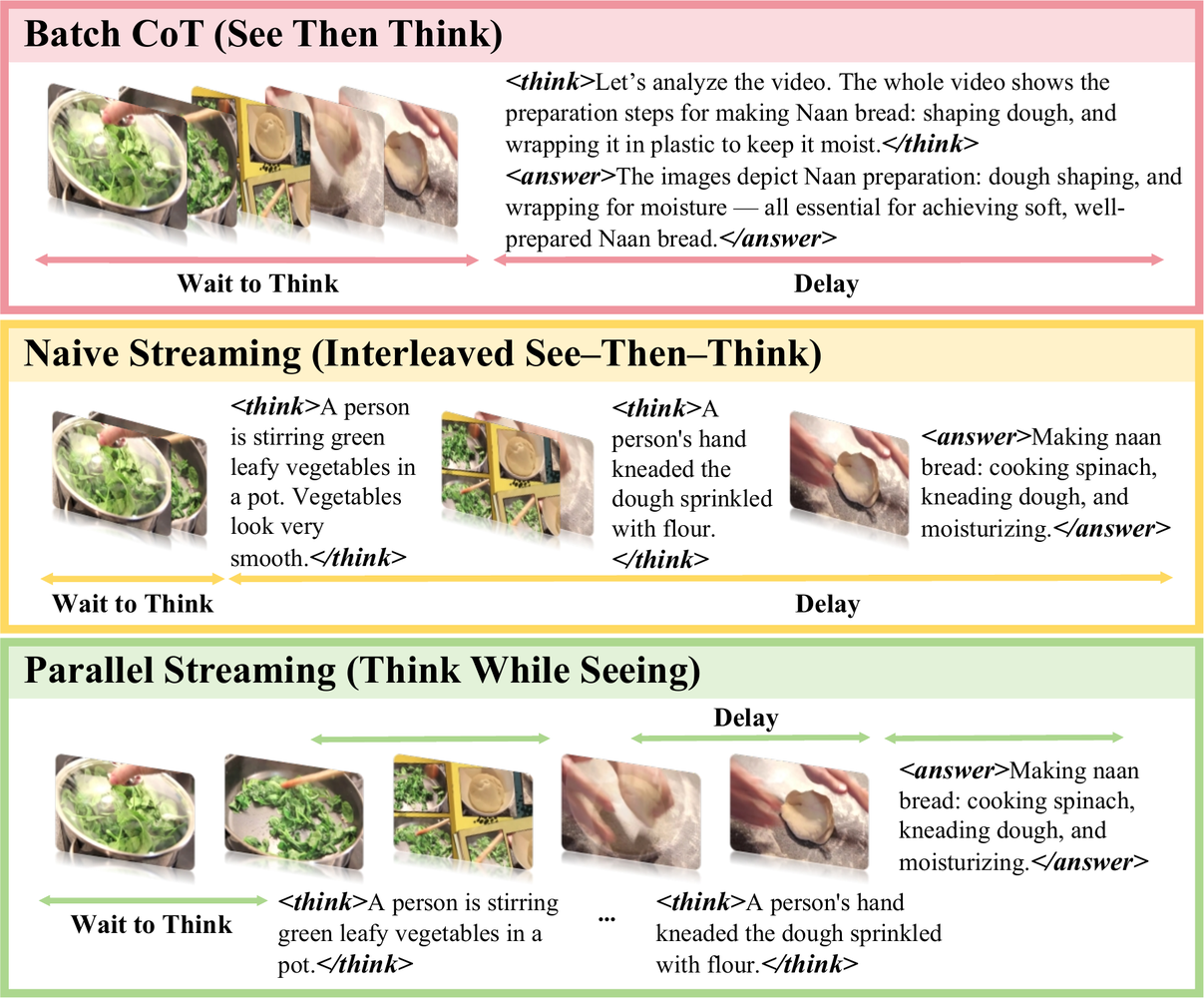 Think-as-You-See: Streaming Chain-of-Thought Reasoning for Large Vision-Language ModelsJialiang Zhang, Junlong Tong, Junyan Lin, Hao Wu, Yirong Sun, Yunpu Ma, and Xiaoyu ShenIn Proceedings of the IEEE/CVF Conference on Computer Vision and Pattern RecognitionJune 2026
Large Vision Language Models (LVLMs) exhibit strong Chain-of-Thought (CoT) capabilities, yet most existing paradigms assume full-video availability before inference, misaligned with real-world video streams where information arrives sequentially. We propose Think-as-You-See (TaYS), a unified framework enabling true concurrent reasoning through parallelized CoT generation, stream-constrained training, and stream-parallel inference. TaYS employs temporally aligned reasoning units, streaming attention masks and positional encodings, and a dual KV-cache that decouples visual encoding from textual reasoning. Evaluated on the Qwen2.5-VL family, TaYS consistently outperforms both batch and interleaved baselines, improving reasoning performance while substantially reducing time-to-first-token and overall reasoning delay.
@inproceedings{zhang2026thinkasyousee, title = {Think-as-You-See: Streaming Chain-of-Thought Reasoning for Large Vision-Language Models}, author = {Zhang, Jialiang and Tong, Junlong and Lin, Junyan and Wu, Hao and Sun, Yirong and Ma, Yunpu and Shen, Xiaoyu}, booktitle = {Proceedings of the IEEE/CVF Conference on Computer Vision and Pattern Recognition}, pages = {11998--12008}, year = {2026}, month = jun, } -
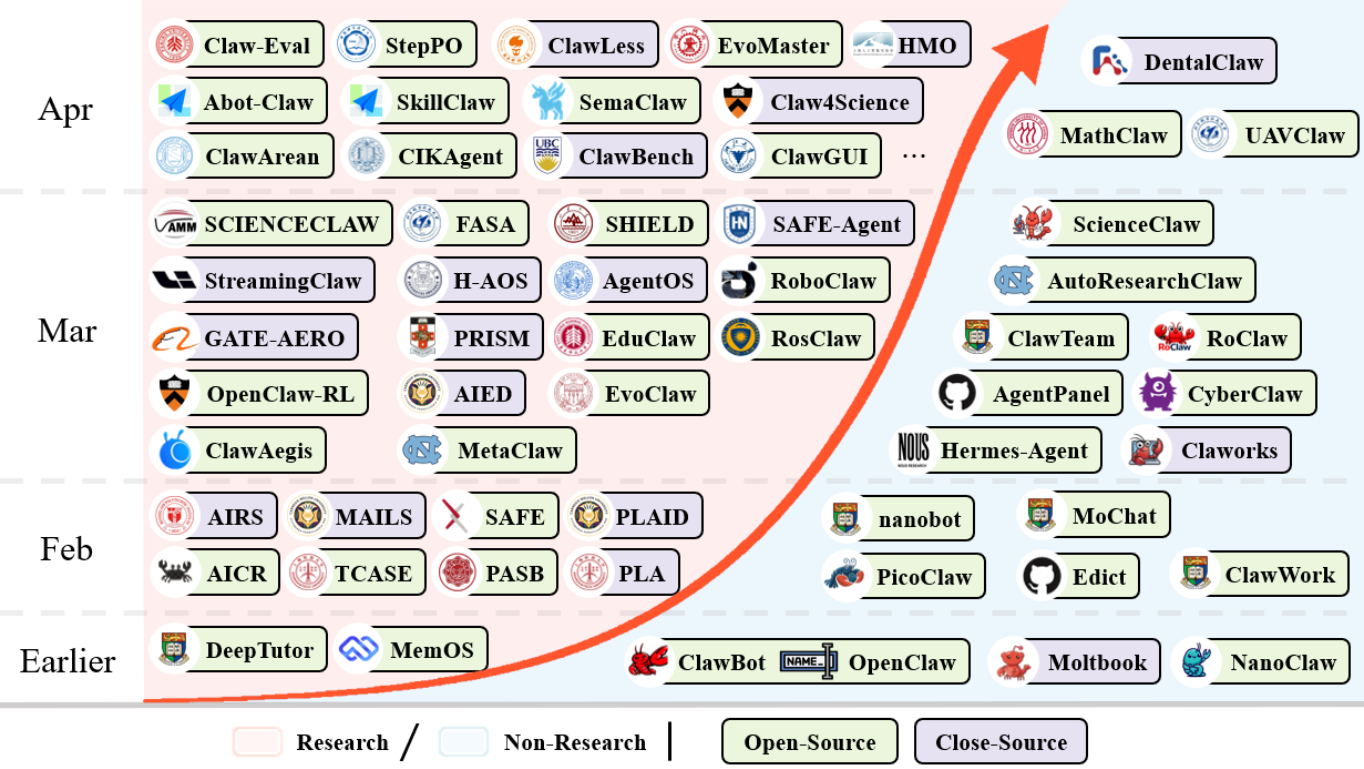 OpenClaw Research: A Systematic Survey of Large Language Model Agents in Open DeploymentShuo Lu, Kecheng Yu, Siru Jiang, Yinuo Xu, Bing Zhan, Yanbo Wang, Changxin Ke, Yuan Xu, Xin Xiong, Xinyun Zhou, and othersMay 2026
Autonomous agents powered by large language models are moving from curated demos to persistent, open-world deployment. The rapid rise of OpenClaw, an open-source project that became one of the most starred in GitHub history, makes this transition concrete: agents can now run continuously, operate across heterogeneous platforms, and use community-contributed skills outside fully curated environments. This shift breaks the sandbox assumptions that have dominated prior agent research, including developer-controlled model updates, trusted tools, constrained environments, and short-lived execution. We present the first systematic survey of OpenClaw Research, defined as the study of agent systems after they enter open deployment. We formalize this setting through an agent-system tuple A = ⟨π, env, pop, substrate⟩ and derive four principles of openness: Open Policy, Open Environment, Open Population, and Open Substrate. These principles structure the taxonomy around five research areas: Learning & Evolving, Safety & Security, Claw Society, Infrastructure & Systems, and Applications. Across these areas, we review representative work, identify emerging risks such as malicious skill supply chains and autonomy–accountability gaps, and highlight open challenges that arise in open, continuously deployed agent systems. This survey provides a roadmap for understanding and governing LLM agents as they move beyond laboratory settings into large-scale open deployment, ultimately laying the groundwork for a trustworthy and sustainable agent ecosystem. To support ongoing research in this field, we maintain an online curated paper list.
@misc{lu2026openclaw, title = {{OpenClaw Research}: A Systematic Survey of Large Language Model Agents in Open Deployment}, author = {Lu, Shuo and Yu, Kecheng and Jiang, Siru and Xu, Yinuo and Zhan, Bing and Wang, Yanbo and Ke, Changxin and Xu, Yuan and Xiong, Xin and Zhou, Xinyun and others}, year = {2026}, month = may, } - ICLR 2026
 StreamingThinker: Large Language Models Can Think While ReadingJunlong Tong, Yingqi Fan, Anhao Zhao, Yunpu Ma, and Xiaoyu ShenIn International Conference on Learning RepresentationsApril 2026
Large language models (LLMs) have demonstrated remarkable capabilities in chain-of-thought reasoning. However, the current LLM reasoning paradigm initiates thinking only after the entire input is available, introducing unnecessary latency in dynamic scenarios. Inspired by human cognition of thinking while reading, we design a streaming thinking paradigm for LLMs, where reasoning unfolds in the order of input. We instantiate this paradigm with StreamingThinker, a framework that enables LLMs to think while reading through the integration of streaming CoT generation, streaming-constraint training, and streaming parallel inference. StreamingThinker yields an 80% reduction in token waiting before the onset of reasoning and more than 60% reduction in time-level latency for producing the final answer.
@inproceedings{tong2025streamingthinker, title = {{StreamingThinker}: Large Language Models Can Think While Reading}, author = {Tong, Junlong and Fan, Yingqi and Zhao, Anhao and Ma, Yunpu and Shen, Xiaoyu}, booktitle = {International Conference on Learning Representations}, year = {2026}, month = apr, } - EACL Findings 2026
 Parameter-Efficient Routed Fine-Tuning: Mixture-of-Experts Demands Mixture of Adaptation ModulesYilun Liu, Yunpu Ma, Yuetian Lu, Shuo Chen, Zifeng Ding, and Volker TrespIn Findings of the Association for Computational Linguistics: EACL 2026March 2026
Mixture-of-Experts (MoE) benefits from a dynamic routing mechanism among specialized experts, which existing Parameter-Efficient Fine-Tuning (PEFT) strategies often fail to leverage. We investigate whether adaptation modules themselves should incorporate routing mechanisms to align with MoE’s multi-expert architecture. We analyze dynamics of core components when applying PEFT to MoE language models and examine how different routing strategies affect adaptation effectiveness. Extensive experiments adapting OLMoE-1B-7B and Mixtral-8x7B on various commonsense and math reasoning tasks validate the performance and efficiency of our routed approach, with practical insights to facilitate better PEFT and MoE applications.
@inproceedings{liu2026perft, title = {Parameter-Efficient Routed Fine-Tuning: Mixture-of-Experts Demands Mixture of Adaptation Modules}, author = {Liu, Yilun and Ma, Yunpu and Lu, Yuetian and Chen, Shuo and Ding, Zifeng and Tresp, Volker}, booktitle = {Findings of the Association for Computational Linguistics: EACL 2026}, pages = {4439--4457}, year = {2026}, month = mar, } - AAAI 2026
 OpenDriveVLA: Towards End-to-End Autonomous Driving with Large Vision Language Action ModelXingcheng Zhou, Xingshuo Han, Fan Yang, Yunpu Ma, Volker Tresp, and Alois KnollIn Proceedings of the AAAI Conference on Artificial IntelligenceMarch 2026
We present OpenDriveVLA, a Vision-Language Action (VLA) model designed for end-to-end autonomous driving, built upon open-source large language models. OpenDriveVLA generates spatially-grounded driving actions by leveraging multimodal inputs including 2D and 3D instance-aware visual representations, ego vehicle states, and language commands. We introduce a hierarchical vision-language alignment process projecting both 2D and 3D structured visual tokens into a unified semantic space. We incorporate structured agent-environment-ego interaction modeling into the autoregressive decoding process, enabling the model to capture fine-grained spatial dependencies critical for reliable trajectory planning. Extensive experiments on nuScenes demonstrate that OpenDriveVLA achieves state-of-the-art results across open-loop trajectory planning and driving-related question-answering tasks.
@inproceedings{zhou2026opendrivevla, title = {{OpenDriveVLA}: Towards End-to-End Autonomous Driving with Large Vision Language Action Model}, author = {Zhou, Xingcheng and Han, Xingshuo and Yang, Fan and Ma, Yunpu and Tresp, Volker and Knoll, Alois}, booktitle = {Proceedings of the AAAI Conference on Artificial Intelligence}, volume = {40}, number = {16}, pages = {13782--13790}, year = {2026}, month = mar, } - AAAI 2026
 ASCD: Attention-Steerable Contrastive Decoding for Reducing Hallucination in MLLMYifan Wang, Aniri, Jinhe Bi, Soeren Pirk, and Yunpu MaIn Proceedings of the AAAI Conference on Artificial IntelligenceMarch 2026
Multimodal large language models (MLLMs) frequently hallucinate by over-committing to spurious visual cues. We empirically show that improvements from contrastive decoding methods systematically coincide with redistributions of cross-modal attention. Building on this insight, we propose Attention-Steerable Contrastive Decoding (ASCD), which directly steers attention scores during decoding by combining positive steering (amplifying text-centric heads) with negative steering (dampening critical visual tokens). The method incurs negligible runtime and memory overhead without additional training. Across five MLLM backbones, ASCD reduces hallucination on POPE, CHAIR, and MMHal-Bench by up to 38.2% while improving accuracy on standard VQA benchmarks.
@inproceedings{wang2026ascd, title = {{ASCD}: Attention-Steerable Contrastive Decoding for Reducing Hallucination in {MLLM}}, author = {Wang, Yifan and Aniri and Bi, Jinhe and Pirk, Soeren and Ma, Yunpu}, booktitle = {Proceedings of the AAAI Conference on Artificial Intelligence}, year = {2026}, month = mar, } - Quantum 2026
 Quantum Architecture Search with Unsupervised Representation LearningYize Sun, Zixin Wu, Volker Tresp, and Yunpu MaQuantumFebruary 2026
Unsupervised representation learning presents new opportunities for advancing Quantum Architecture Search (QAS) on Noisy Intermediate-Scale Quantum (NISQ) devices. QAS is designed to optimize quantum circuits for Variational Quantum Algorithms (VQAs). Most QAS algorithms tightly couple the search space and search algorithm, requiring the evaluation of numerous quantum circuits with high computational costs. Predictor-based QAS algorithms mitigate this by estimating circuit performance from structure or embedding, but often demand time-intensive labeling. Inspired by the classical neural architecture search algorithm Arch2vec, we investigate the potential of unsupervised representation learning for QAS without relying on predictors. Our framework decouples unsupervised architecture representation learning from the search process and integrates an improved quantum circuit graph encoding scheme. During the search, we employ REINFORCE and Bayesian Optimization to explore the latent representation space. We further validate by executing the best-discovered MaxCut circuits on IBM quantum hardware, confirming that the architectures retain optimal performance under real hardware noise.
@article{sun2026quantumarchitecture,
  title = {Quantum Architecture Search with Unsupervised Representation Learning},
  author = {Sun, Yize and Wu, Zixin and Tresp, Volker and Ma, Yunpu},
  journal = {Quantum},
  volume = {10},
  pages = {1994},
  year = {2026},
  month = feb,
}
2025
- EMNLP 2025
 METok: Multi-Stage Event-Based Token Compression for Efficient Long Video UnderstandingMengyue Wang, Shuo Chen, Kristian Kersting, Volker Tresp, and Yunpu MaIn Proceedings of the 2025 Conference on Empirical Methods in Natural Language ProcessingNovember 2025
Recent advances in Video Large Language Models (VLLMs) have enhanced their ability to understand video content, but processing long videos remains challenging due to high computational demands and visual redundancy. We propose METok, a training-free, Multi-stage Event-based Token compression framework designed to accelerate VLLMs’ inference while preserving accuracy. METok progressively eliminates redundant visual tokens across three stages: (1) event-aware compression during vision encoding, (2) hierarchical token pruning based on semantic alignment and event importance, and (3) a decoding-stage KV Cache optimization. Equipping LongVA-7B with METok realizes an 80.6% FLOPs reduction and 93.5% KV Cache memory savings while maintaining comparable or superior accuracy.
@inproceedings{wang2025metok, title = {{METok}: Multi-Stage Event-Based Token Compression for Efficient Long Video Understanding}, author = {Wang, Mengyue and Chen, Shuo and Kersting, Kristian and Tresp, Volker and Ma, Yunpu}, booktitle = {Proceedings of the 2025 Conference on Empirical Methods in Natural Language Processing}, pages = {18870--18884}, year = {2025}, month = nov, } - EMNLP 2025
 SwarmAgentic: Towards Fully Automated Agentic System Generation via Swarm IntelligenceYao Zhang, Chenyang Lin, Shijie Tang, Haokun Chen, Shijie Zhou, Yunpu Ma, and Volker TrespIn Proceedings of the 2025 Conference on Empirical Methods in Natural Language ProcessingNovember 2025
Existing agentic system generation frameworks lack full autonomy, missing from-scratch agent generation, self-optimizing agent functionality, and collaboration. We propose SwarmAgentic, the first framework that fully automates agentic system generation, optimization, and collaboration, constructing agents from scratch and jointly refining functionality and coordination via language-driven exploration. To enable efficient search over system-level structures, SwarmAgentic maintains a population of candidate systems and evolves them via feedback-guided updates, drawing inspiration from Particle Swarm Optimization. Given only a task description and an objective function, SwarmAgentic outperforms all baselines, achieving a +261.8% relative improvement over ADAS on the TravelPlanner benchmark.
@inproceedings{zhang2025swarmagentic, title = {{SwarmAgentic}: Towards Fully Automated Agentic System Generation via Swarm Intelligence}, author = {Zhang, Yao and Lin, Chenyang and Tang, Shijie and Chen, Haokun and Zhou, Shijie and Ma, Yunpu and Tresp, Volker}, booktitle = {Proceedings of the 2025 Conference on Empirical Methods in Natural Language Processing}, pages = {1778--1818}, year = {2025}, month = nov, } - ACL 2025
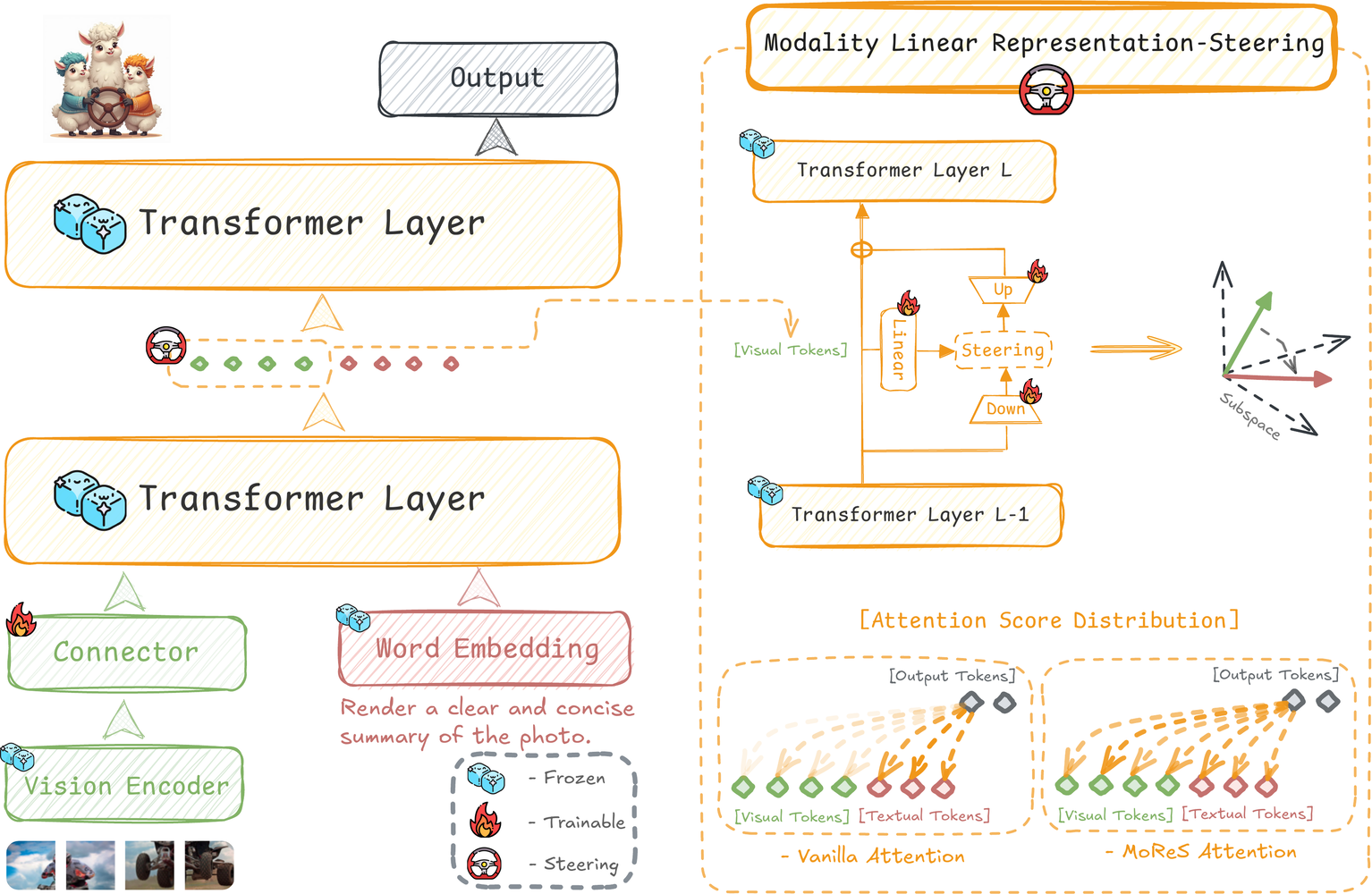 LLaVA Steering: Visual Instruction Tuning with 500x Fewer Parameters through Modality Linear Representation-SteeringJinhe Bi, Yujun Wang, Haokun Chen, Xun Xiao, Artur Hecker, Volker Tresp, and Yunpu MaIn Proceedings of the 63rd Annual Meeting of the Association for Computational LinguisticsJuly 2025
Multimodal Large Language Models (MLLMs) have significantly advanced visual tasks by integrating visual representations into large language models. Our research reveals a persistent imbalance between text and visual modalities, with text often dominating output generation during visual instruction tuning. We introduce Modality Linear Representation-Steering (MoReS), which re-balances the intrinsic modalities by steering visual representations through linear transformations in the visual subspace across each model layer. The composed LLaVA Steering models require, on average, 500 times fewer trainable parameters than LoRA needs while achieving comparable performance across three visual benchmarks and eight visual question-answering tasks.
@inproceedings{bi2025llava, title = {{LLaVA} Steering: Visual Instruction Tuning with 500x Fewer Parameters through Modality Linear Representation-Steering}, author = {Bi, Jinhe and Wang, Yujun and Chen, Haokun and Xiao, Xun and Hecker, Artur and Tresp, Volker and Ma, Yunpu}, booktitle = {Proceedings of the 63rd Annual Meeting of the Association for Computational Linguistics}, pages = {15230--15250}, year = {2025}, month = jul, } - TMLR 2025
 DyGMamba: Efficiently Modeling Long-Term Temporal Dependency on Continuous-Time Dynamic Graphs with State Space ModelsZifeng Ding, Yifeng Li, Yuan He, Antonio Norelli, Jingcheng Wu, Volker Tresp, Yunpu Ma, and Michael BronsteinTransactions on Machine Learning ResearchMay 2025
Learning useful representations for continuous-time dynamic graphs (CTDGs) is challenging, due to the concurrent need to span long node interaction histories and grasp nuanced temporal details. Two problems emerge: (1) Encoding longer histories requires more computational resources, making it crucial for CTDG models to maintain low computational complexity; (2) More powerful models are needed to identify and select the most critical temporal information within extended contexts. We propose DyGMamba, a CTDG representation learning model originating from the popular Mamba state space model (SSM). DyGMamba first leverages a node-level SSM to encode the sequence of historical node interactions. Another time-level SSM then exploits temporal patterns hidden in the historical graph, where its output is used to dynamically select critical information from the interaction history. DyGMamba achieves state-of-the-art in most cases while maintaining high efficiency, making it possible to capture long temporal dependencies with a limited computation budget.
@article{ding2025dygmamba, title = {{DyGMamba}: Efficiently Modeling Long-Term Temporal Dependency on Continuous-Time Dynamic Graphs with State Space Models}, author = {Ding, Zifeng and Li, Yifeng and He, Yuan and Norelli, Antonio and Wu, Jingcheng and Tresp, Volker and Ma, Yunpu and Bronstein, Michael}, journal = {Transactions on Machine Learning Research}, year = {2025}, month = may, } - AAAI 2025
 WebPilot: A Versatile and Autonomous Multi-Agent System for Web Task Execution with Strategic ExplorationYao Zhang, Zijian Ma, Yunpu Ma, Zhen Han, Yu Wu, and Volker TrespIn Proceedings of the AAAI Conference on Artificial IntelligenceApril 2025
LLM-based autonomous agents often fail to execute complex web tasks that require dynamic interaction, largely due to the inherent uncertainty and complexity of these environments. We develop WebPilot, a multi-agent system with a dual optimization strategy that improves MCTS to better handle complex web environments. The Global Optimization phase generates a high-level plan by breaking down tasks into manageable subtasks, continuously refined through reflective analysis. The Local Optimization phase executes each subtask using a tailored MCTS that iteratively refines decisions based on new observations. Experimental results on WebArena and MiniWoB++ demonstrate the effectiveness of WebPilot, achieving SOTA performance with GPT-4 and a 93% relative increase in success rate over the concurrent tree search-based method.
@inproceedings{zhang2025webpilot,
  title = {{WebPilot}: A Versatile and Autonomous Multi-Agent System for Web Task Execution with Strategic Exploration},
  author = {Zhang, Yao and Ma, Zijian and Ma, Yunpu and Han, Zhen and Wu, Yu and Tresp, Volker},
  booktitle = {Proceedings of the AAAI Conference on Artificial Intelligence},
  year = {2025},
  month = apr,
}
2024
- EMNLP Findings 2024
 VideoINSTA: Zero-Shot Long Video Understanding via Informative Spatial-Temporal Reasoning with LLMsRuotong Liao, Max Erler, Huiyu Wang, Guangyao Zhai, Gengyuan Zhang, Yunpu Ma, and Volker TrespIn Findings of the Association for Computational Linguistics: EMNLP 2024November 2024
In the video-language domain, recent works in leveraging zero-shot Large Language Model-based reasoning for video understanding have become competitive challengers to previous end-to-end models. Long video understanding presents unique challenges due to the complexity of reasoning over extended timespans. We propose VideoINSTA, i.e., INformative Spatial-TemporAl Reasoning for zero-shot long-form video understanding. VideoINSTA contributes (1) a zero-shot framework for long video understanding using LLMs; (2) an event-based temporal reasoning and content-based spatial reasoning approach for LLMs to reason over spatial-temporal information in videos; (3) a self-reflective information reasoning scheme based on information sufficiency and prediction confidence. Our model significantly improves the state-of-the-art on three long video question-answering benchmarks: EgoSchema, NextQA, and IntentQA.
@inproceedings{liao2024videoinsta, title = {{VideoINSTA}: Zero-Shot Long Video Understanding via Informative Spatial-Temporal Reasoning with {LLM}s}, author = {Liao, Ruotong and Erler, Max and Wang, Huiyu and Zhai, Guangyao and Zhang, Gengyuan and Ma, Yunpu and Tresp, Volker}, booktitle = {Findings of the Association for Computational Linguistics: EMNLP 2024}, pages = {6577--6602}, year = {2024}, month = nov, } - NAACL Findings 2024
 GenTKG: Generative Forecasting on Temporal Knowledge Graph with Large Language ModelsRuotong Liao, Xu Jia, Yangzhe Li, Yunpu Ma, and Volker TrespIn Findings of the Association for Computational Linguistics: NAACL 2024June 2024
The rapid advancements in large language models (LLMs) have ignited interest in the temporal knowledge graph (tKG) domain, where conventional embedding-based and rule-based methods dominate. The question remains open of whether pre-trained LLMs can understand structured temporal relational data and replace them as the foundation model for temporal relational forecasting. We bring temporal knowledge forecasting into the generative setting with GenTKG, a novel retrieval-augmented generation framework combining a temporal logical rule-based retrieval strategy and few-shot parameter-efficient instruction tuning. Extensive experiments show that GenTKG outperforms conventional methods using as few as 16 training samples, and highlights remarkable cross-domain generalizability on unseen datasets without re-training.
@inproceedings{liao2024gentkg,
  title = {{GenTKG}: Generative Forecasting on Temporal Knowledge Graph with Large Language Models},
  author = {Liao, Ruotong and Jia, Xu and Li, Yangzhe and Ma, Yunpu and Tresp, Volker},
  booktitle = {Findings of the Association for Computational Linguistics: NAACL 2024},
  pages = {4303--4317},
  year = {2024},
  month = jun,
}
2023
- GECCO 2023
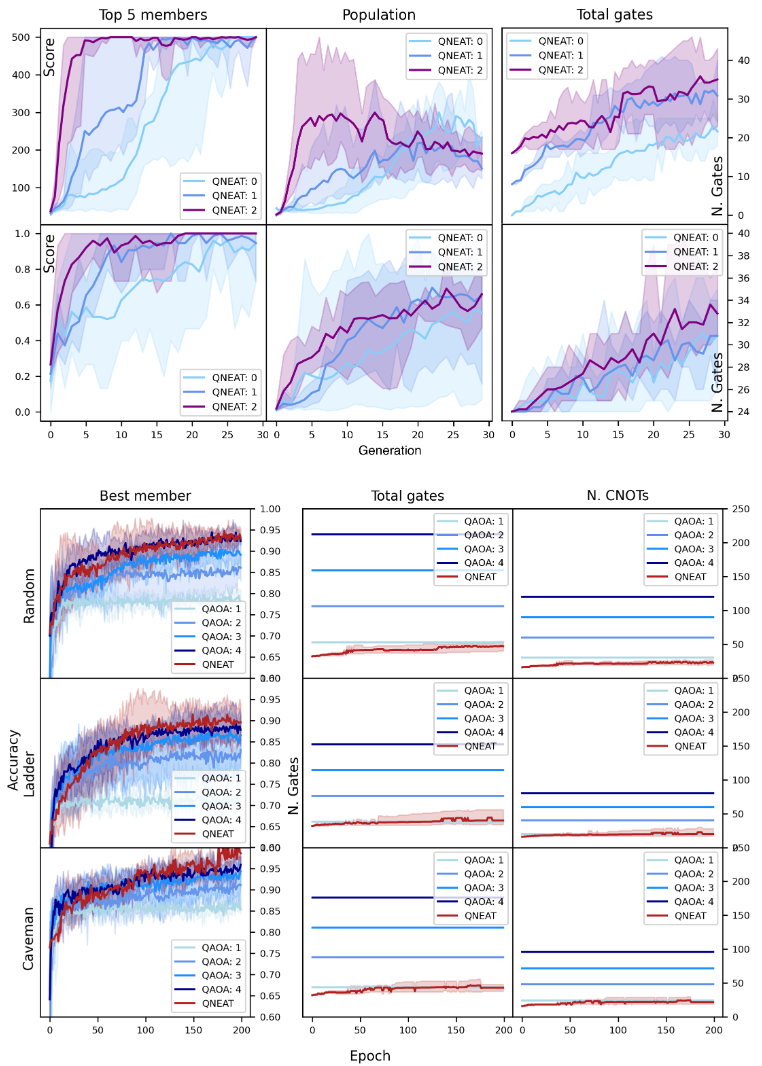 QNEAT: Natural Evolution of Variational Quantum Circuit ArchitectureAlessandro Giovagnoli, Volker Tresp, Yunpu Ma, and Matthias SchubertIn Proceedings of the Companion Conference on Genetic and Evolutionary ComputationJuly 2023
Quantum Machine Learning (QML) is a recent and rapidly evolving field where the theoretical framework and logic of quantum mechanics are employed to solve machine learning tasks. Various techniques with different levels of quantum-classical hybridization have been proposed. Here we focus on variational quantum circuits (VQC), which emerged as the most promising candidates for the quantum counterpart of neural networks in the noisy intermediate-scale quantum (NISQ) era. Although showing promising results, VQCs can be hard to train because of different issues, e.g., barren plateau, periodicity of the weights, or choice of architecture. This paper focuses on this last problem for finding optimal architectures of variational quantum circuits for various tasks. To address it, we propose a gradient-free algorithm inspired by natural evolution to optimize both the weights and the architecture of the VQC. In particular, we present a version of the well-known neuroevolution of augmenting topologies (NEAT) algorithm and adapt it to the case of variational quantum circuits. We refer to the proposed architecture search algorithm for VQC as QNEAT.
@inproceedings{giovagnoli2023qneat,
  title = {{QNEAT}: Natural Evolution of Variational Quantum Circuit Architecture},
  author = {Giovagnoli, Alessandro and Tresp, Volker and Ma, Yunpu and Schubert, Matthias},
  booktitle = {Proceedings of the Companion Conference on Genetic and Evolutionary Computation},
  pages = {647--650},
  year = {2023},
  month = jul,
}